Table of contents
- 1.The full process at a glance
- 2.Step 1: Hood & filter degreasing
- 3.Step 2: Burner & range cleaning
- 4.Step 3: Wall & floor degreasing
- 5.Step 4: Cold room cleaning
- 6.Step 5: Drain cleaning
- 7.Step 6: Pest-preventive sanitization
- 8.Crew size and duration
- 9.Quality checks during the process
- 10.Handover and reporting
- 11.What goes wrong when steps are skipped
- 12.Get a free quote
- 13.Frequently asked questions
Quick answer
Professional restaurant kitchen cleaning runs through a survey, then 1) hood & filter degreasing, 2) burner & range cleaning, 3) wall & floor degreasing, 4) cold room cleaning, 5) drain cleaning, 6) pest-preventive sanitization, and ends with a supervisor walk-through and a completion report. Each step is done in order and photographed before the crew moves to the next one.
Key takeaways
- Every step runs in a fixed order, not an ad-hoc sequence
- Photos at each stage are what turn a promise into proof
- A supervisor walk-through happens before handover, not after payment
- The report is kept for your records, audits or AGM
- Typical crew and duration: A typical 2,000–5,000 sq.
- Skipping or reordering steps is how jobs go wrong — see below
The full process at a glance
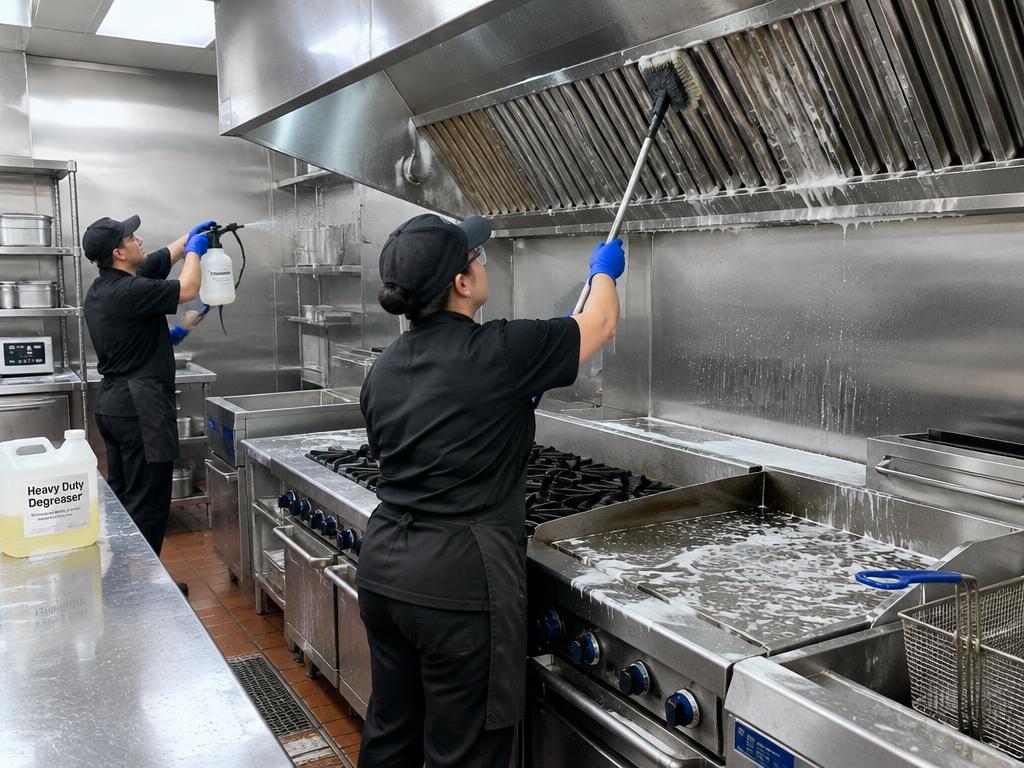
Here's the order a proper restaurant kitchen cleaning job follows, from first visit to handover:
- Site survey and planning
- Hood & filter degreasing
- Burner & range cleaning
- Wall & floor degreasing
- Cold room cleaning
- Drain cleaning
- Pest-preventive sanitization
- Walk-through and handover
Step 1: Hood & filter degreasing
Our crew completes "hood & filter degreasing" using the appropriate equipment — typically colour-coded microfiber cloths to prevent cross-contamination — and the right safety gear for this step, before photographing the result and moving on.
This is usually the step that reveals the real condition of the site, which is why the earlier site survey matters — it sets expectations for what this step will actually involve.
Step 2: Burner & range cleaning
Our crew completes "burner & range cleaning" using the appropriate equipment — typically glass squeegees and extension poles for high glazing — and the right safety gear for this step, before photographing the result and moving on.
Getting this step wrong is one of the more common ways a rushed job falls short: a deep clean rushed to save time typically skips high-dusting (vents, lights, top of cupboards), leaves washroom grout and drain odours untreated, and polishes floors without stripping old residue first — so the shine doesn't last.
Step 3: Wall & floor degreasing
Our crew completes "wall & floor degreasing" using the appropriate equipment — typically ph-neutral and alkaline degreasers — and the right safety gear for this step, before photographing the result and moving on.
Getting this step wrong is one of the more common ways a rushed job falls short: a deep clean rushed to save time typically skips high-dusting (vents, lights, top of cupboards), leaves washroom grout and drain odours untreated, and polishes floors without stripping old residue first — so the shine doesn't last.
Step 4: Cold room cleaning
Our crew completes "cold room cleaning" using the appropriate equipment — typically steam cleaners for grout, washrooms and kitchens — and the right safety gear for this step, before photographing the result and moving on.
Getting this step wrong is one of the more common ways a rushed job falls short: a deep clean rushed to save time typically skips high-dusting (vents, lights, top of cupboards), leaves washroom grout and drain odours untreated, and polishes floors without stripping old residue first — so the shine doesn't last.
Step 5: Drain cleaning
Our crew completes "drain cleaning" using the appropriate equipment — typically injection-extraction carpet and upholstery machines — and the right safety gear for this step, before photographing the result and moving on.
Getting this step wrong is one of the more common ways a rushed job falls short: a deep clean rushed to save time typically skips high-dusting (vents, lights, top of cupboards), leaves washroom grout and drain odours untreated, and polishes floors without stripping old residue first — so the shine doesn't last.
Step 6: Pest-preventive sanitization
Our crew completes "pest-preventive sanitization" using the appropriate equipment — typically industrial dry and wet vacuum cleaners — and the right safety gear for this step, before photographing the result and moving on.
Getting this step wrong is one of the more common ways a rushed job falls short: a deep clean rushed to save time typically skips high-dusting (vents, lights, top of cupboards), leaves washroom grout and drain odours untreated, and polishes floors without stripping old residue first — so the shine doesn't last.
Crew size and duration
A typical 2,000–5,000 sq. ft. office is cleaned by a crew of 4–8 staff with a supervisor in 4–8 hours overnight or over a weekend. Large-format sites like malls and hospitals run in planned zones with a rotating crew so operations are never fully shut down.
Quality checks during the process
Our supervisor checks for these before marking any step complete:
- No odour in washrooms, pantry or carpeted areas a day after the clean
- Floors and glass are streak-free, not just damp-mopped
- High areas (vents, lights, tops of cupboards) are visibly dust-free
- A supervisor walk-through report is provided with photos
- Staff or visitor complaints drop in the weeks after the service
Handover and reporting
The supervisor walks through the completed work with you, shares before/after photos and a written report, and agrees the next service date before the crew leaves.
What goes wrong when steps are skipped
A deep clean rushed to save time typically skips high-dusting (vents, lights, top of cupboards), leaves washroom grout and drain odours untreated, and polishes floors without stripping old residue first — so the shine doesn't last. The space looks clean on day one but reverts within a week, forcing another paid visit sooner than planned.
Restaurant Kitchen Cleaning is a good example of exactly this.
Need restaurant kitchen cleaning?
Free site survey and fixed written quote. Rates from ₹8,000–₹35,000 per kitchen.
Available in Mumbai, Navi Mumbai, Thane, Panvel.
Frequently asked questions
Written and maintained by the Commercial Cleaning Mumbai team, based on hands-on restaurant kitchen cleaning jobs across Mumbai, Navi Mumbai, Thane and Panvel. We review this page whenever our process, pricing or guidance changes, and the "updated" date above always reflects the last review.