Table of contents
Quick answer
Most properties need water tank cleaning every 6 months as a minimum, and every 3–4 months for tanks filled by tankers, borewells, or serving a hospital, hotel or food business. High-traffic sites, food businesses and hospitals need it more often, and the two highest-priority windows each year are just before and just after the monsoon. Keep dated records so you can prove the interval was followed.
Key takeaways
- Standard frequency: every 6 months as a minimum, and every 3–4 months for tanks filled by tankers, borewells, or serving a hospital, hotel or food business
- Pre- and post-monsoon are the two most important visits of the year
- Food businesses, hospitals and hotels should shorten the interval
- Keep dated records for audits, AGMs and disputes
- Set a fixed schedule with an annual contract so it's never missed
- Act sooner if any of the warning signs below show up
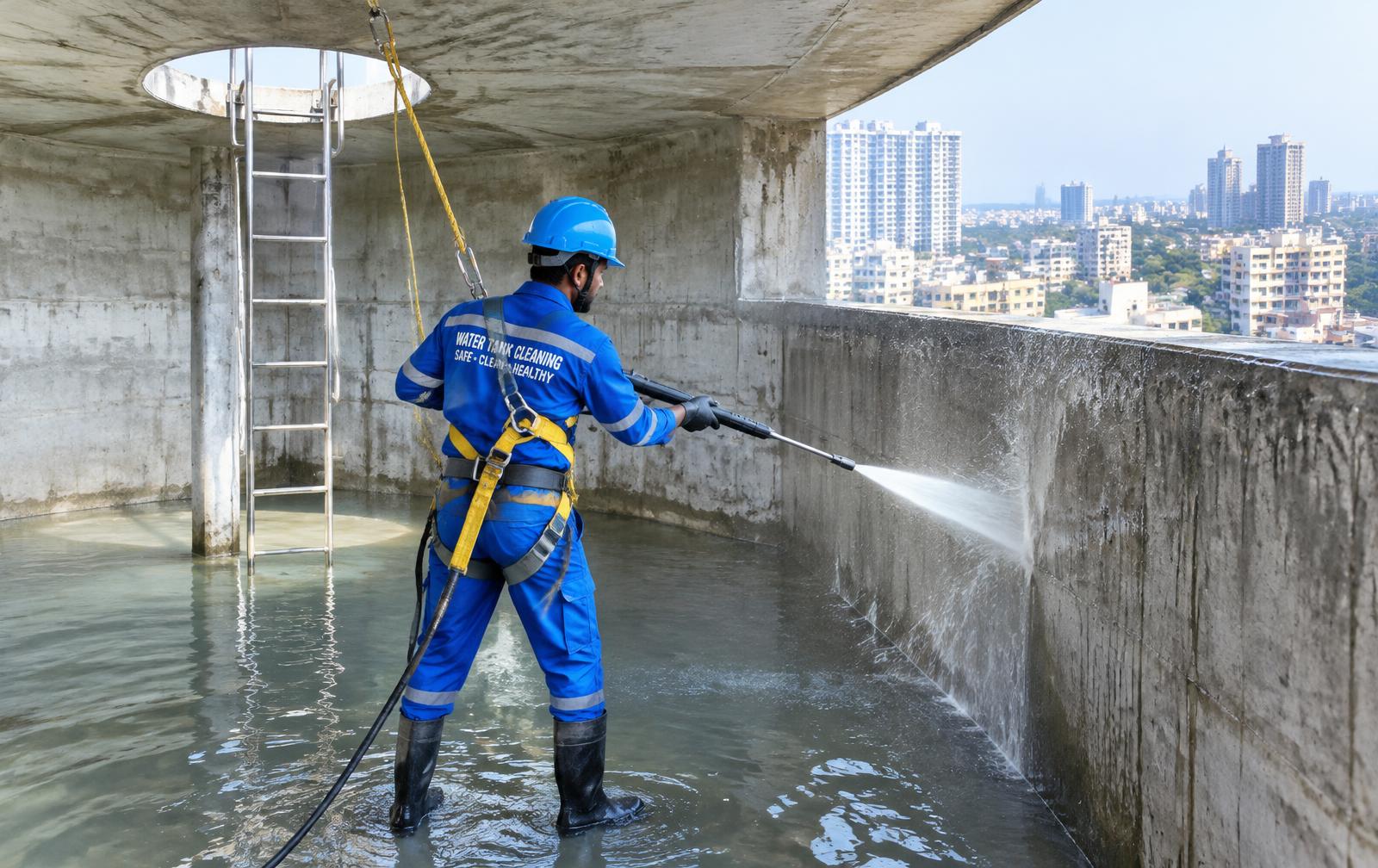
Recommended frequency
Clients usually ask this once, then want it on a calendar so it never comes up again.
For housing society managing committees, facility and maintenance managers, hospital and hotel engineering teams, school administrators and factory EHS officers, we recommend water tank cleaning every 6 months as a minimum, and every 3–4 months for tanks filled by tankers, borewells, or serving a hospital, hotel or food business.
Frequency by property type
Here's how that recommendation changes depending on what kind of site it is:
| Property type / scenario | Recommended frequency | Why |
|---|---|---|
| Housing society (municipal supply) | Every 6 months | Standard sediment and biofilm build-up |
| Tanker-filled or borewell-fed tank | Every 3–4 months | Tanker and borewell water carries more silt and variable quality |
| Hospital, clinic or food business | Every 3 months, or per internal hygiene schedule | Higher hygiene expectations under NABH/FSSAI-style norms |
| Hotel or large commercial building | Every 3–4 months | High water usage and guest- or occupant-facing supply |
| School or factory | Every 6 months, before term or shift restart | Long closures let sediment settle undisturbed |
Best time of year
Book once in April–May before the monsoon, when the tank is about to receive turbid water, and once in October–November after the rains to remove the silt the monsoon left behind.
During the monsoon, tanks fill faster with turbid, silt-heavy water from tankers or municipal lines, and leaking terrace waterproofing or loose manhole covers let rainwater and debris in. Algae growth also accelerates in warm, humid conditions if a lid doesn't seal properly. This is why a pre-monsoon clean (April–May) and a post-monsoon clean (October–November) are the two most important visits of the year, even for sites already on a 6-month schedule.
When to book sooner than scheduled
Move your date up if you notice:
- Complaints from residents, staff or guests
- Visible dirt, odour or stains before the next scheduled date
- An upcoming audit, inspection or event
- Flooding, renovation or a long closure
- A change in water source, usage pattern or occupancy
Good to know
If health symptoms are involved (stomach upset, skin irritation), treat it as urgent and don't wait for the next scheduled date.
Why skipping an interval hurts
Dirty tanks hold sludge, algae, rust flakes and bacteria such as E. coli that cause typhoid, jaundice, diarrhoea and skin infections. Because one tank feeds every tap in the building, a single missed cleaning cycle puts every resident, patient, guest or employee at risk, not just one unit.
This holds true for water tank cleaning specifically, not just in general.
What changes the interval for your site
In Mumbai, Navi Mumbai, Thane and Panvel, tanks are commonly a mix of rooftop plastic/Sintex tanks, RCC overhead tanks, and underground sumps or UGRs that receive BMC/NMMC/TMC supply plus tanker top-ups during shortages. High-rise societies often run twin tanks per wing, while standalone commercial buildings may rely on one large underground sump feeding a hydro-pneumatic system — this changes access planning and crew size from site to site.
Keeping to the schedule
Contract clients get scheduled visits and reminders, so water tank cleaning happens on date rather than after someone notices a problem. Commercial Cleaning Mumbai can align this with your AGM, audit or financial-year calendar.
Need water tank cleaning?
Free site survey and fixed written quote. Rates from ₹1.5–₹3 per litre capacity.
Available in Mumbai, Navi Mumbai, Thane, Panvel.
Frequently asked questions
Written and maintained by the Commercial Cleaning Mumbai team, based on hands-on water tank cleaning jobs across Mumbai, Navi Mumbai, Thane and Panvel. We review this page whenever our process, pricing or guidance changes, and the "updated" date above always reflects the last review.