Table of contents
Quick answer
Professional water tank cleaning is the better choice for most commercial properties and societies because it brings mechanized equipment, trained crews, safe chemicals and a documented report. In-house staff are well suited to daily upkeep between visits, but not to the deep or higher-risk work itself.
Key takeaways
- In-house staff are suited to daily upkeep, not deep or high-risk work
- Professionals bring equipment, training, insurance and a report
- A documented report protects you in audits, AGMs and disputes
- Total cost is often similar once avoided risk and redo work are counted
- The right split is professional for the scheduled deep work, in-house for the days in between
- Hazards involved in this category make professional handling the safer default
In-house vs professional, honestly
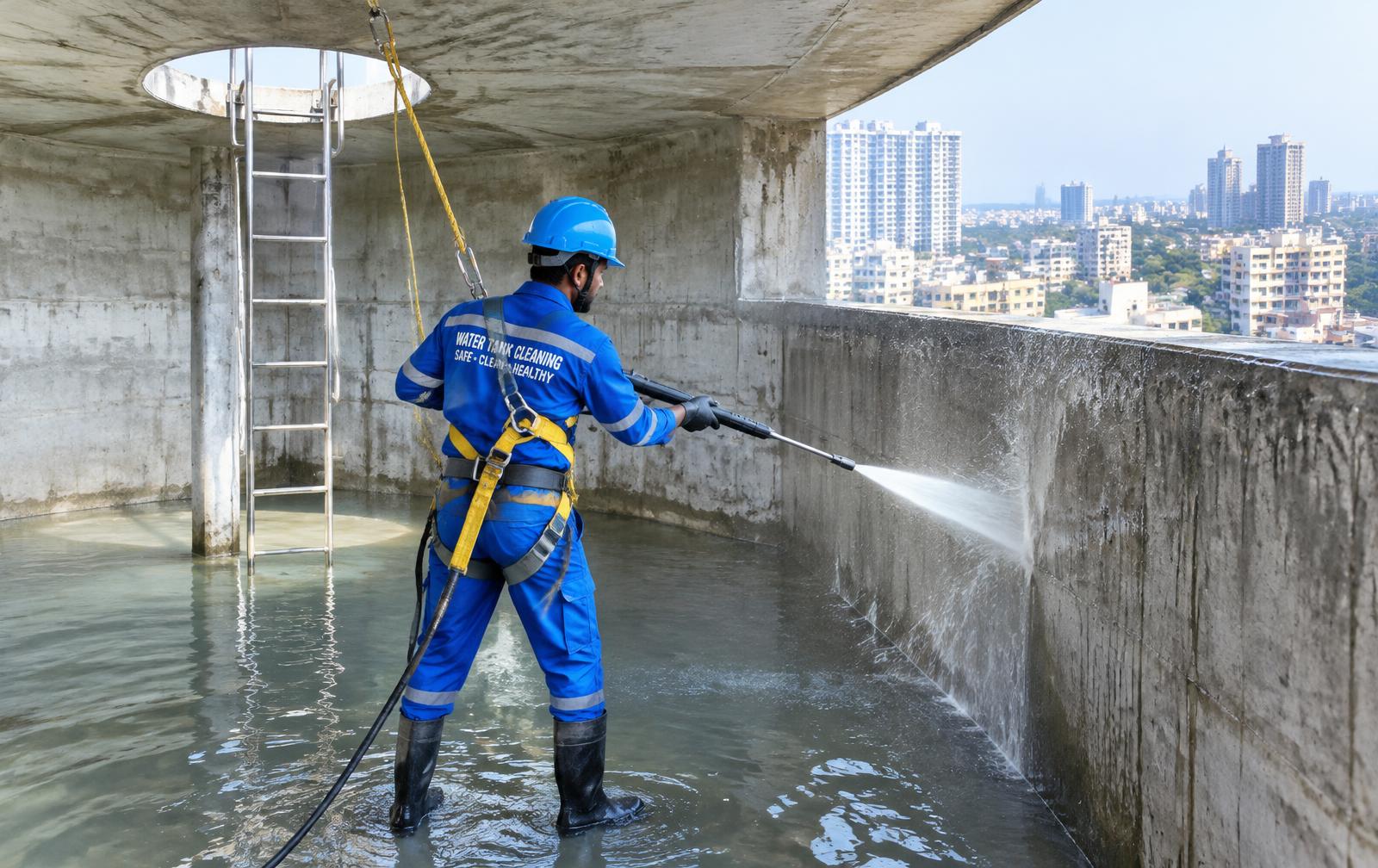
Manual cleaning by building staff usually removes surface dirt but leaves sludge in corners, risks suffocation in underground tanks and gives no disinfection proof. Professional mechanized cleaning uses pumps, high-pressure jets, vacuum extraction, anti-bacterial spray and UV, and gives you a report.
Side-by-side comparison
Here's how the two approaches actually compare, factor by factor:
| Factor | In-house / DIY | Professional service |
|---|---|---|
| Equipment | Basic tools and household-grade products | Mechanized equipment — submersible dewatering pump, sludge/slurry suction pump or vacuum extractor, among others |
| Safety training | Often informal, little height/confined-space training | Trained crew with PPE and a documented safety process |
| Results | Surface-level, inconsistent between staff | Deep clean to a written scope, consistent each visit |
| Proof of work | None, usually | Before/after photos and a completion report |
| Typical cost | Looks free, but hides redo and risk cost | From ₹1.5–₹3 per litre capacity, with the redo risk already priced in |
Where the real risk is
A rushed or incomplete tank clean leaves sludge in corners and under inlet pipes, so algae and bacteria regrow within weeks. Skipping disinfection contact time means pathogens can survive even after the tank looks visually clean, and skipping the final rinse leaves chemical residue in drinking water. Both are common when a vendor is paid per visit with no written scope or inspection.
Good to know
Suffocation or gas exposure inside underground tanks and sumps — always gas-test and ventilate before entry
When in-house is genuinely enough
Daily sweeping, mopping, dusting and bin clearing can reasonably stay in-house. The scheduled deep or technical work is where professional help earns its cost — book that part out.
What a professional crew adds beyond the equipment
Beyond machines, you're paying for a trained housing society managing committees-facing process: a written scope, a supervisor, safety protocol and a report you can actually use. It's one of the first things our crews check on every water tank cleaning visit.
A fair way to compare the real cost
In-house looks cheaper on paper because staff time is a sunk cost that doesn't show up as a line item. Once you add the cost of redo work, complaints, or an incident from untrained handling, professional water tank cleaning at ₹1.5–₹3 per litre capacity is usually the cheaper option over a year, not the more expensive one.
Need water tank cleaning?
Free site survey and fixed written quote. Rates from ₹1.5–₹3 per litre capacity.
Available in Mumbai, Navi Mumbai, Thane, Panvel.
Frequently asked questions
Written and maintained by the Commercial Cleaning Mumbai team, based on hands-on water tank cleaning jobs across Mumbai, Navi Mumbai, Thane and Panvel. We review this page whenever our process, pricing or guidance changes, and the "updated" date above always reflects the last review.